DanVex AD Series — Adsorption Dehumidifiers for Cold and Low-RH Environments
DanVex AD Series is a range of adsorption (desiccant) dehumidifiers across two complementary lines: the AD Compact (0.6–3 kg/h, single-phase 220–230 V, < 45–65 dB) for archives, server rooms, restoration work, and concealed installations; and the AD Industrial (5–36 kg/h, three-phase 380–415 V) for pharmaceutical cleanrooms, lithium battery dry rooms, ice rinks, cold storage, and food production. Adsorption technology works where condensation cannot — at ambient temperatures down to −20 °C and target humidity down to 1% RH. Across the range: Proflute silica gel rotor, dual-fan design, Modbus RTU RS-485 for direct BMS integration, EN60204 electrical, and no drainage required.
About the Range
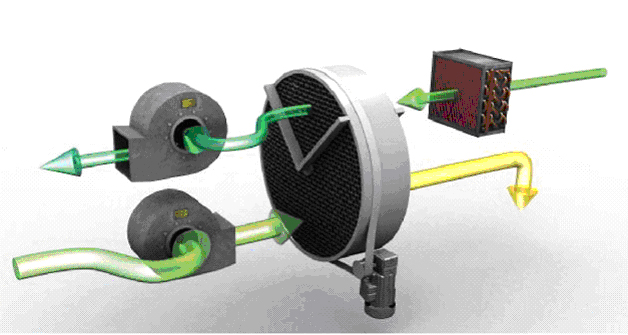
Adsorption dehumidification removes moisture from air by passing it through a slowly rotating silica gel rotor — the same physical principle used in industrial desiccant dryers, scaled for room-level and facility-level installation. Unlike condensation (refrigerant) dehumidifiers, adsorption stays efficient at low temperatures and reaches dew points well below freezing. This is the technology to choose when the operating environment is colder than +10 °C, when the target humidity is below 30% RH, or when both conditions apply — cold storage, freezers, ice rinks, pharmaceutical and battery dry rooms, archives in unheated buildings.
The DanVex AD range is organised into two product lines that share the same core engineering — Proflute silica gel rotor, dual-fan design, ducted installation, no drainage — but differ in scale and electrical infrastructure. The AD Compact Series (AD-200, AD-400, AD-550) runs on standard single-phase 220–230 V supply, operates at < 45–65 dB, fits into concealed installations, and is housed in AISI 304 stainless steel. The AD Industrial Series (AD-800, AD-1000, AD-1500, AD-3000, AD-5000) runs on three-phase 380–415 V, scales from 5 to 36 kg/h, and on the upper two models (AD-3000 / AD-5000) adds a programmable PLC controller with 7″ touchscreen and anti-cold-bridge double-skin polyurethane housing.
How Adsorption Works
A slowly rotating silica gel rotor — the desiccant element — is divided into two zones: roughly 75% of the face area handles process air (the room or duct being dried), and 25% handles regeneration air (a smaller, hot stream that drives moisture out of the silica gel and exhausts it outside). The rotor turns continuously, so each segment cycles between adsorbing moisture from the room and giving it up to the regeneration stream. The two streams stay physically separated and are driven by two independent fans — the dual-fan design.
Three engineering points matter for the buyer. First, no drainage is required — moisture leaves the unit as warm vapour through the regeneration duct, not as condensate. This simplifies installation and removes a recurring failure point (frozen drain lines in cold-storage applications). Second, low-temperature performance is fundamentally different. Refrigerant dehumidifiers depend on cooling air below its dew point and stop working efficiently below roughly +5 °C ambient. Adsorption is a chemical-affinity process, not a thermodynamic one — it works as long as there is some moisture in the air, even at −20 °C. Third, dual-fan design preserves room pressure. Single-fan desiccant units pull regeneration air from the same room they are drying, depressurising the space and pulling in untreated outside air through gaps. DanVex AD units use two independent fans — process and regeneration — with the regeneration stream taken from outside, so the room stays neutral.
In practice this means:
Engineering Standards Across the Range
What separates an industrial-grade adsorption dehumidifier from a consumer-grade desiccant is a set of design decisions that hold across both the Compact and Industrial lines. These are the standards every DanVex AD model is built to.
Proflute silica gel rotor
Rotor manufactured by Proflute — one of two leading European desiccant rotor producers. Consistent capacity at design conditions, predictable adsorption isotherm, 5–8 year lifespan in non-corrosive service with regeneration below 140 °C. Project sizing in the original Proflute rotor selection software.
Dual-fan design
Process and regeneration air streams are driven by two independent fans. Room pressure is preserved (no depressurisation as with single-fan configurations), the regeneration stream can be ducted to outside or to a separate exhaust, and capacity is not eroded by the regen flow consuming room air.
−20 °C to +60 °C operating range
Adsorption stays efficient where condensation fails — below +5 °C ambient the refrigerant cycle on conventional dehumidifiers loses capacity rapidly and below 0 °C it ices over and capacity collapses. The DanVex AD range operates continuously from −20 °C up to +40 °C (Compact and smaller Industrial) or +60 °C (AD-3000, AD-5000).
Down to 1% RH
Target humidity reachable by the technology — the limit applies in idealised conditions of inlet temperature and airflow. For pharmaceutical cleanrooms, lithium battery dry rooms, semiconductor and electronics manufacturing, and other low-RH targets that refrigerant dehumidifiers cannot reach.
Cabinets across the range
Compact cabinets in AISI 304 stainless steel (IP44). Industrial cabinets in powder-coated steel; the upper two models (AD-3000 / AD-5000) add a double-skin polyurethane panel with anti-cold-bridge aluminium frame, and cabinet surface free of condensation under normal operating conditions.
Modbus RTU RS-485 + EN60204
BMS integration is standard, not an option — Modbus RTU RS-485 protocol on every model in both series, no protocol gateway required for SCADA or facility monitoring. Electrical assemblies built to EN60204 (industrial machinery safety), Class I electrical protection, IP44 (Compact) or IPX3 (Industrial) ingress, IP54 / class F insulation on Industrial fan motors.
How to Choose — Decision Guide
Before sizing by capacity, identify the right technology and series. Adsorption is the correct choice when room temperature is low, target humidity is low, or both — otherwise condensation dehumidification is more economical in typical industrial conditions.
| Your situation | Recommended series | Why |
|---|---|---|
| Cold environment (below +10 °C) or very low target RH (below 30%) — cold storage, freezers, pharma dry rooms, archives in unheated buildings — with single-phase 220–230 V supply or quiet operation required | AD Compact | Single-phase 220–230 V, < 45–65 dB, AISI 304 stainless steel, IP44, ducted installation. Models: AD-200, AD-400, AD-550 (0.6–3 kg/h) |
| Plant-scale or facility-wide adsorption installation with three-phase supply — pharmaceutical cleanrooms, lithium battery dry rooms, ice rinks, food production with low-RH targets, large cold storage | AD Industrial | Three-phase 380–415 V, 5–36 kg/h, electric regeneration heater, Modbus RTU on lower models, programmable PLC + 7″ touchscreen on AD-3000 / AD-5000, anti-cold-bridge housing on top two models |
| Typical industrial environment, +15 °C and above, target RH 40–60% (warehouses, food production at room temperature, manufacturing halls, plant cultivation rooms) — condensation dehumidification is more energy-efficient | DEH-K Stationary | Refrigerant-cycle stationary industrial dehumidifiers (DEH-K Series), 200–1000 L/day, Full Inverter on 3K / 5K / 10K, R-32 refrigerant, top-discharge airflow. Lower energy cost per litre of water removed in the conditions where condensation works |
The DanVex AD Range
AD Compact Series
0.6–3 kg/h · 180–550 m³/h process · 220–230 V single-phase · < 45–65 dB · AISI 304 · IP44
Quiet, ducted, single-phase adsorption units for concealed installation. AISI 304 stainless steel housing, G3 air filter, Modbus RTU RS-485, auto-restart, settings memory. For cold storage, archives and museums, small pharmaceutical rooms, restoration work, and specialty manufacturing. Models: AD-200, AD-400, AD-550.
View AD Compact Series →AD Industrial Series
5–36 kg/h · 820–5000 m³/h process · 380–415 V three-phase · −20 °C to +60 °C (AD-3000/5000) · IPX3
Three-phase, high-capacity, ducted adsorption units for plant-scale installation. Proflute silica gel rotor, dual-fan design with belt-driven rotor rotation, G4 plate filter, Modbus RTU. AD-3000 and AD-5000 add programmable PLC + 7″ touchscreen, anti-cold-bridge double-skin polyurethane housing. Models: AD-800, AD-1000, AD-1500, AD-3000, AD-5000.
View AD Industrial Series →Find by Application
| Application | Recommended series |
|---|---|
| Cold storage, cold rooms, freezers | AD Compact (small rooms) or AD Industrial (large warehouses) |
| Pharmaceutical cleanrooms & dry rooms | AD Industrial (PLC + 7″ touch on AD-3000 / AD-5000) |
| Lithium battery & semiconductor dry rooms | AD Industrial — for < 1% RH targets |
| Ice rinks | AD Industrial (typically AD-3000 / AD-5000) |
| Food production with low-RH targets (powders, confectionery, freeze-drying, spices) | AD Industrial |
| Archives, museums | AD Compact — quiet, concealed installation |
| Defence & military storage (ammunition, electronics, equipment) | AD Compact or AD Industrial by volume |
| Plastic injection moulding — resin pellet drying | AD Industrial |
| Paper & cardboard mills | AD Industrial |
| Water-damage restoration in cold weather | AD Compact — for sub-zero conditions where mobile refrigerant units stall |
| Restoration workshops, conservation labs | AD Compact |
Find by Capacity
| Capacity needed | Model | Type / supply |
|---|---|---|
| up to 0.6 kg/h | AD-200 | Compact / single-phase / < 45 dB |
| up to 2.2 kg/h | AD-400 | Compact / single-phase / < 50 dB |
| up to 3 kg/h | AD-550 | Compact / single-phase / < 65 dB |
| up to 5 kg/h | AD-800 | Industrial / three-phase |
| up to 7 kg/h | AD-1000 | Industrial / three-phase |
| up to 11 kg/h | AD-1500 | Industrial / three-phase |
| up to 21.6 kg/h | AD-3000 | Industrial / three-phase / PLC + 7″ touch |
| up to 36 kg/h | AD-5000 | Industrial / three-phase / PLC + 7″ touch |
| > 36 kg/h | Multiple AD Industrial units in parallel | Project-specific sizing |
Capacity figures measured at 20 °C / 60% RH (industry standard test condition for desiccant dehumidifiers). Real-world capacity depends on inlet temperature, RH, and airflow. For sub-zero applications, specific moisture removal stays high but absolute capacity decreases with air density — contact us for project-specific sizing using the original Proflute rotor selection software.
For HVAC Engineers and Project Designers
The DanVex AD range is built around the same industrial-grade standards across both ranges:
- Proflute silica gel rotor — manufactured by Proflute, one of two leading European desiccant rotor producers. 5–8 year lifespan in non-corrosive service with regeneration below 140 °C; predictable adsorption isotherm for thermodynamic modelling
- Project sizing in original Proflute software — we use the rotor manufacturer’s own selection software for project-based sizing, with full thermodynamic modelling of process and regeneration streams. This is more accurate than rule-of-thumb sizing by room volume
- Dual-fan design — independent process and regeneration fans on every model; room pressure preserved, capacity not eroded by regen consuming room air
- BMS-ready — Modbus RTU RS-485 standard on every model in both series; direct integration with SCADA, building management systems, and facility monitoring without protocol gateways
- EN60204 electrical standard — assemblies built to industrial machinery safety standard; Class I electrical protection; IP44 (Compact) / IPX3 (Industrial) ingress protection; IP54 with class F insulation on Industrial fan motors
- Anti-cold-bridge double-skin housing (AD-3000, AD-5000) — injected polyurethane panel with aluminium frame and thermal break, cabinet surface free of condensation under normal operating conditions
- Programmable PLC + 7″ touchscreen (AD-3000, AD-5000) — humidity and temperature controller with customisable setpoints, schedules, alarm thresholds, and full RS-485 telemetry. Industrial-grade circuit components and relays from established European manufacturers
- No drainage required — moisture leaves the unit as warm vapour through the regeneration duct, not as condensate. Simplifies installation, removes the recurring failure point of frozen drain lines in cold-storage applications
- Technical documentation & engineering support — full datasheets, wiring diagrams, dimensional drawings, and BMS integration notes on request to qualified contractors. Project-specific moisture-load calculations and on-site assistance via dealer network across Europe and the Middle East
FAQ — Frequently Asked Questions
What is the difference between adsorption and condensation dehumidification?
When should I choose adsorption over condensation?
Why does adsorption work at temperatures where condensation fails?
How does the silica gel rotor work?
Why do you use dual-fan design instead of single-fan?
What is the energy cost of regeneration?
Do I need a drain connection?
Can I combine adsorption and condensation in one project?
How long does the silica gel rotor last?
Do AD units integrate with BMS?
How do you size the right model for my project?
Explore Further
- AD Compact Series — quiet single-phase adsorption dehumidifiers, 0.6–3 kg/h
- AD Industrial Series — three-phase adsorption dehumidifiers, 5–36 kg/h
- Industrial Dehumidifiers — mobile vs stationary, how to choose
- DEH-K Series — condensation stationary dehumidifiers, 200–1000 L/day
- DEH-i Series — mobile industrial dehumidifiers, 59–180 L/day
- DanVex HUM Series — industrial ultrasonic humidifiers

